 Mahjong Pages
Learn mahjong
How to play mahjong with 2 or 3 players
Yes, you can play American mahjong with two or three people. Under the National Mah Jongg League's rules you still build four walls and deal 13 tiles each (14 to the dealer), but you skip the Charleston and start with the dealer's first discard.
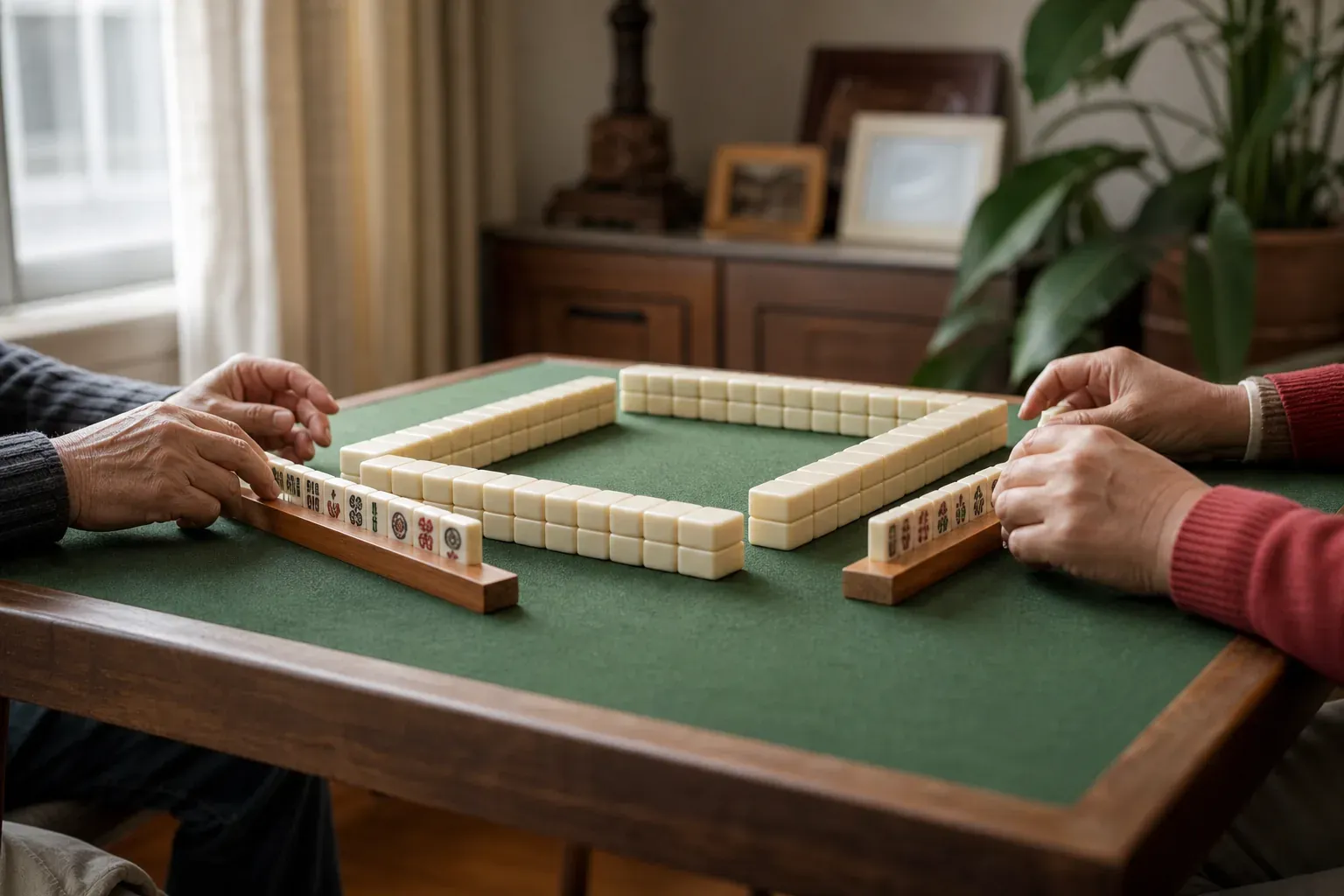
Last checked November 25, 2026.
The official rules for three players
The League’s rulebook covers games with fewer than four players. As summarised by rules author Tom Sloper, who cites the official rulebook:
- Build four walls as usual. The empty seat still gets a wall.
- Deal only to the three players. Each takes four tiles at a time until everyone holds 12.
- Finish the deal. The dealer ends with 14 tiles and the other two players with 13.
- Skip the Charleston.
- Start play with the dealer’s first discard. Everything else is the same as the four-player game.
The League has described the last step of the deal in slightly different ways over the years (its January 2024 newsletter has the dealer take the next two tiles, then the others take one each). The result is the same: 14 for the dealer, 13 for the others. Pick one method and use it all session.
The official rules for two players
Two-player American mahjong follows the same pattern:
- Sit opposite each other.
- Build all four walls.
- Deal 14 tiles to the dealer and 13 to the other player. No tiles are dealt to the empty seats.
- Skip the Charleston.
- The dealer discards and play alternates.
With only two players drawing from 152 tiles, hands are slower to come together through discards, and more of your tiles come from the wall.
Can you keep the Charleston with three players?
Officially, no. In practice, many groups dislike playing without it and agree a table rule. Common versions include:
- A dummy hand. Deal 13 tiles to the empty seat. Players pass to and take from that stack as if it were a fourth player.
- Passing to the wall. Players swap tiles with a set of tiles taken from the empty seat’s wall.
There is no official way to run a table rule. Before the first hand, agree the details: whether a joker picked up from the dummy can be kept, and in what order tiles are taken. Then stick to it for the whole session.
What is Siamese mahjong?
Siamese mahjong is a two-player version of the American game in which each player works on two hands at once, using the same League card. It was created as a way for two people to get a full, competitive game, and it has its own published rule sheet. It is a table variant, not part of the League’s official rules.
If you have only two players and find the standard two-player game slow, it is the most widely played alternative.
What about a fifth or sixth player?
Extra players rotate in. With five, one player sits out each hand: when a hand ends, the dealer steps away and the waiting player takes that seat. With six, two sit out and rotate in the same way.
Which should you choose?
| Players | Simplest option | If you want more action |
|---|---|---|
| 2 | Official rules, no Charleston | Siamese mahjong |
| 3 | Official rules, no Charleston | Agree a dummy-hand Charleston |
| 5 or 6 | Rotate players in after each hand |
Need a fourth?
Most clubs and open play nights welcome players who come alone, and organisers seat you at a table of four. Find a game near you.
Common questions
- Can you play mahjong with two players?
- Yes. Sit opposite each other, build all four walls, deal 14 tiles to the dealer and 13 to the other player, skip the Charleston, and play as normal.
- Can you play mahjong with three players?
- Yes. Build four walls and deal only to the three players. The official rules skip the Charleston, although many groups agree a table rule to keep one.
- Can you play mahjong alone?
- The four-player game needs opponents, but you can practise alone by dealing yourself a hand and working out which hands on the card it could become. The matching game sold as mahjong solitaire is a different game that uses the same tiles.